How to Play in the Pocket on Bass (It's Not a Technique Problem)
Jul 20, 2026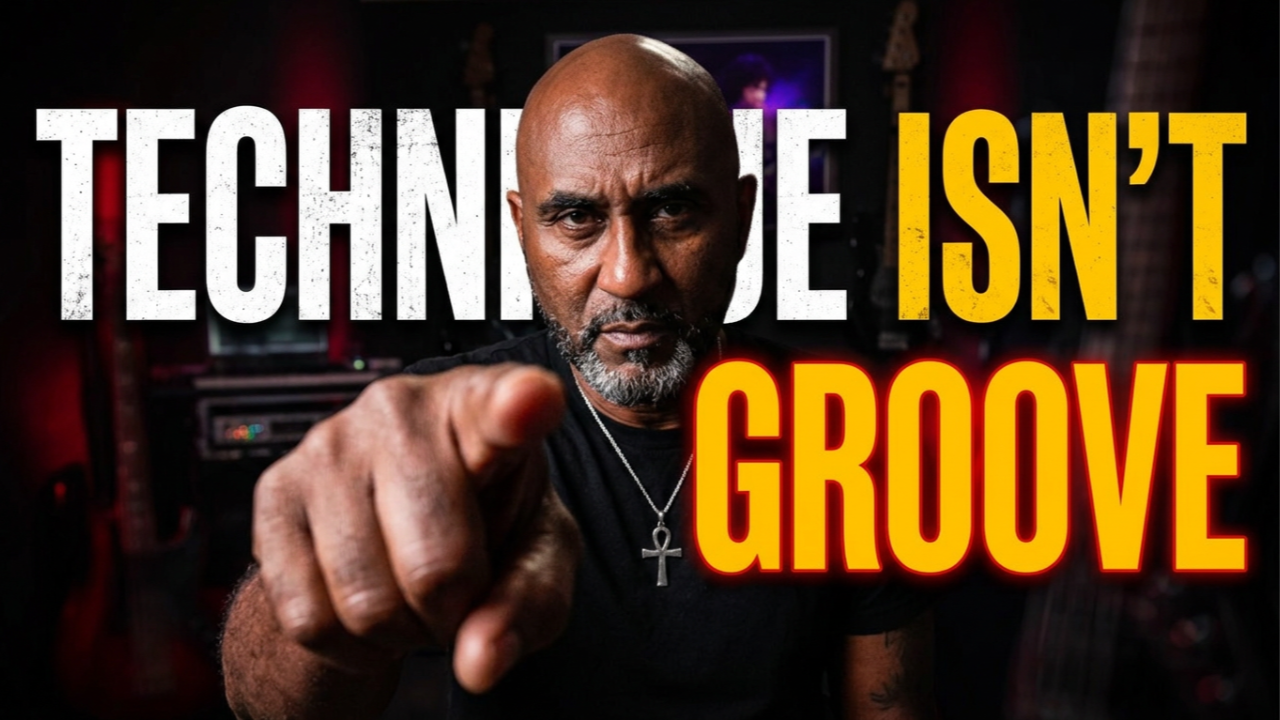
This post is for bass players who search "how to play in the pocket bass" and walk away with a pile of vague, esoteric answers that don't actually change how they play.
By the end, you'll understand why pocket has nothing to do with your hands or your ear, and what to fix instead.
- Step 1: Stop blaming your technique
- Step 2: Understand how musical time actually works
- Step 3: Feel time in your body before you touch the bass
- Step 4: Use a 5-day system to rebuild that relationship
Stop Blaming Your Technique
Search "how to play in the pocket bass" and you'll find a lot of well-meaning, esoteric explanations. Pocket is a feeling. Groove is a conversation. All true. None of it tells you what to actually do on Tuesday when you're practicing alone.
Here's the real reason most bass players can't find the pocket. It's not your hands. It's not your ear. It's that you have a bad relationship with time itself.
Most players run straight to the instrument and try to get the physical part down before they understand what's happening around them. That's backwards. You're trying to fix a translation problem by practicing harder on the thing you're translating into, instead of the thing you're translating from.
Musical Time Works Like Clock Time
Musical time isn't a mystery. It works the same way clock time does. Once it starts, it keeps moving. That's it. There's no secret formula, no esoteric feel you either have or don't.
The reason this feels complicated is that most bass players only experience time through the instrument, where it's abstract, a number on a metronome, a tempo marking on a chart. Time stops feeling abstract the moment you notice it's already running through your body all day, whether you're holding a bass or not.
Feel Time Before You Touch the Bass
Your body already tracks time. Your instrument has nothing to do with it yet. You already know a hundred tempos. You've walked all of them. Your heartbeat has a pulse. A ceiling fan has a subdivision.
The gap most players feel between "I can tap my foot to this song perfectly" and "I can't play this song's groove on bass" isn't a talent gap. It's a translation gap. You're fluent in time already. You just haven't built the bridge from your body to your instrument yet, and that bridge is trainable.
A 5-Day System to Rebuild It
This is why I built The Pocket Path, a free 5-day worksheet that isn't bass drills, isn't lifting weights, isn't CrossFit for your hands. It's five days of physical activity, natural movement you already do every day, built to reconnect you with time before you ever pick up the instrument.
Five days. One idea a day. One physical activity a day. No bass required until Day 5. It's the fastest way I know to close the gap between what your body already feels and what your hands can actually play.
I truly believe this. It ain't rocket science. It's pocket science. Grab the worksheet, do the five days, and tell me in the comments: when's the last time you actually felt a tempo instead of counting it?