How to Get Better at Bass When You Feel Stuck
Jun 23, 2026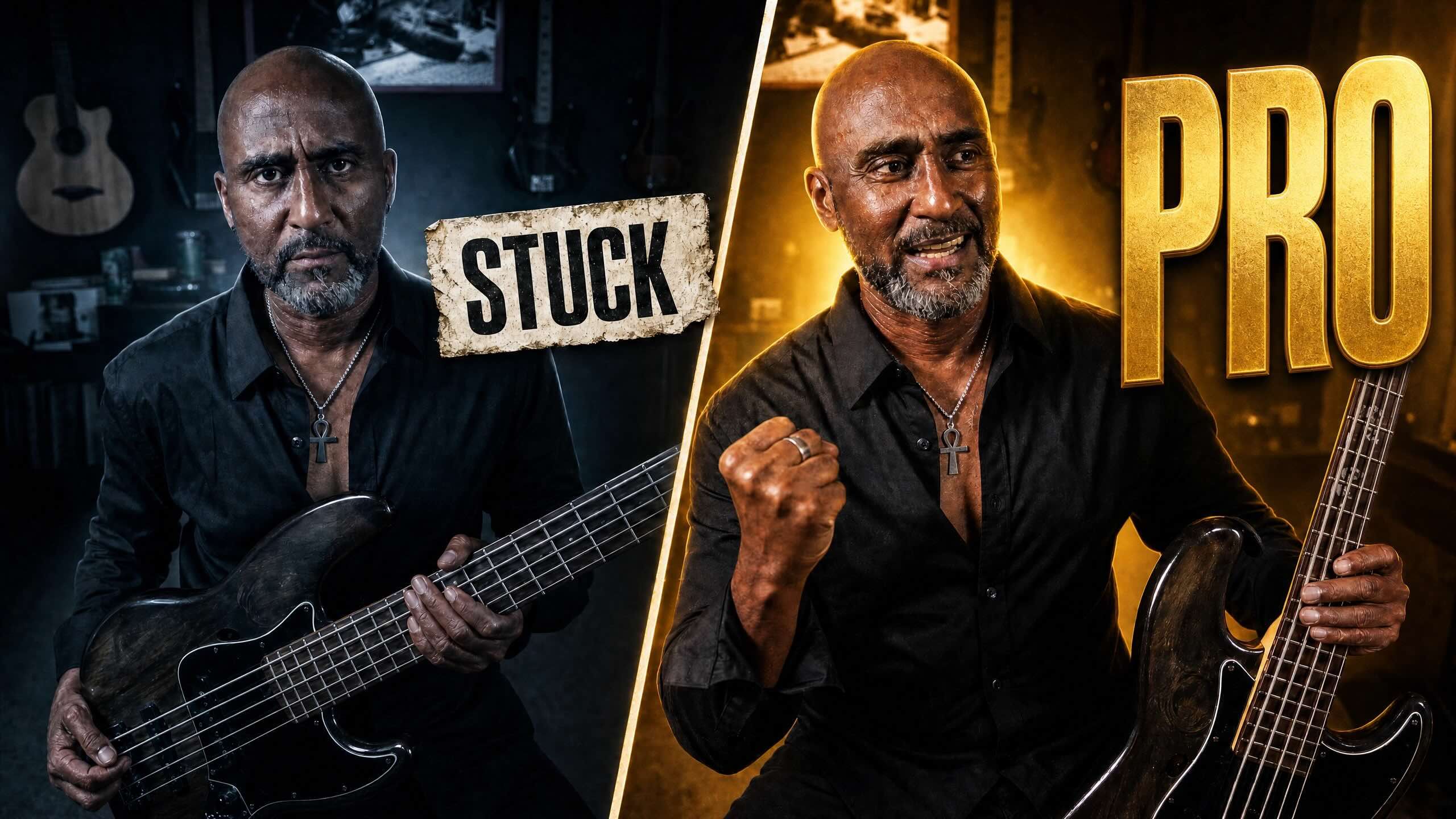
You're not a beginner anymore. You can play some songs, you know a few scales, and you might even have a little theory under your belt. But somewhere along the way, you hit a wall. Progress slowed down. Practice started feeling aimless. And every time you open YouTube, you'r
If that sounds familiar, this post is for you.
I've spent more than 30 years as a professional bassist — eight of those years in the bass chair with funk legend Zigaboo Modeliste of The Meters. I've played club dates, tours, church gigs, sessions, and blue-collar gigs more than
I'm not telling you that to impress you. I'm telling you that because I've spent a long time helping bass players get unstuck, including myself. And what I've learned is that breaking through a plateau isn't about finding the right exercise or the right YouTube channel. It's abou
Start Here: Two Questions That Change Everything
Before we talk about practice, technique, or theory, I want you to answer two questions honestly.
-
Question one: What kind of music do you want to play?
-
Question two: Who can you imagine yourself playing that music with?
Be specific. Not "I want to be a better bassist" — that's too vague to act on. Think about the actual music. Do you want to play at church? In a cover band? Do you want to play funk, blues, jazz? Jam with friends on weekends? Just make music you enjoy?
Once you can answer those two questions, something powerful happens. Every lesson, every exercise, every YouTube short, every practice routine, every "must-know technique" — all of it can be filtered through one simple question: Does this get me closer to my goal, or further away
Most adult bass players aren't trying to become internet famous or session monsters. They want to make real music with real people. And once you know where you're trying to go, it becomes much easier to decide what deserves your attention.
Do You Actually Enjoy Learning?
The second question I ask every student is this: Do you actually enjoy learning?
Not succeeding. Not being good. Learning. Because those aren't the same thing.
I sp ent years working professionally before I ever went to school. I could play. I could learn songs by ear. I was already working. But I couldn't read music — not that you need to, but I wanted to. So at 35 years old, I went back to school. I started reading. I started studying upr
But what I discovered was that I loved learning. I loved the process. I loved the challenge, the discovery, and the gradual improvement. The thing that changed everything for me wasn't talent — whatever talent even is — and it wasn't information. It was learning how to enjoy
So ask yourself: Can you embrace the struggle? Can you tolerate being uncomfortable? Can you enjoy the process even when the results don't show up immediately?
Because if you can learn to love learning, you'll never really be stuck. You'll just be in the middle of the next chapter.
The 4-Question Framework: What to Ask Every Time You Practice
Whether you study with me, another teacher, a course, a book, or a YouTube channel, these four questions should guide every single practice session. They apply across the boa
Ever
1. Can I Play It?
This is your physical relationship with the instrument. Can you play a groove, a phrase, a passage, or a motif repeatedly — with minimal mistakes? Not once, but consistently? Or are you relearning it every time you pick up the bass?
Consistency matters because consistency creates confidence. If you can only play something correctly when the stars align, you don't really know it yet. The goal is to own it — to be able to reproduce it reliably, under pressure, in context.
2. Can I Hear It?
Music is an audio art form. It's audible. Your ears should be leading the process, not following it.
Can you hear when you've played something out of context? Can you hear a note before you play it? Do you have a picture in your mind of what "right" sounds like? Ear training isn't a separate subject you study once and che
3. Can I See It?
Can you visualize the neck when the bass is in your hands? Can you see the notation, the chord progression, the fingerings in your mind?
When I was preparing recital material in college, I didn't always have time to sit down and practice. I was running a business, I was newly married, I had responsibilities. But I had the music in my mind. I could visualize difficult passages. I could mentally rehearse fingerings when the bass wasn't with me. That mental practice wa
The ability to see the music in your mind is a skill, and it's one most players never deliberately develop.
4. Can I Explain It?
Could you explain what you're working on to another musician?
Ther e's a big difference between saying "I'm working on the first four measures of Autumn Leaves — I'm outlining ascending arpeggios and navigating a two-five-one progression" and saying "I'm practicing this thing." The ability to explain something is
S
The Final Principle: Deliberate Practice
Practice does not have to be fun. But you do need to enjoy the process of learning — and there is a difference.
Ever ything you practice should serve a purpose. Everything you practice should move you closer to your goals. Remember those first two questions: what kind of music do you want to play, and who can you imagine yourself playing it with?
Deliberate practice means practicing with intention. It means knowing why you're working on something, not just what you're working on. It means measuring progress against your actual goals, not against some abstract standard of "being good."
When you combine a clear goal, a love of learning, and the four-question framework, you stop treading water. You stop collecting lessons and start building something real.
Ready to Go Deeper?
If this resonated with you, you're ready for the next step.
Groo ve School is the community I built for bass players who are done treading water. It's the system that makes the whole instrument make sense — so you can learn any groove, trust your ear, and show up anywhere with c
The first 100 members get in at $29/month. After that, it goes to $47. No exceptions.
👉
Not ready for that yet? Start here:
👉
Ted has been a professional bassist for over 30 years. He spent eight years in the bass chair with funk legend Zigaboo Modeliste of The Meters, has taught music on the West Coast and in New Orleans, and holds a music degree from California State University, East Bay. He creates bass education content at