How to Build a Bass Groove (Without Overthinking It)
Jun 18, 2026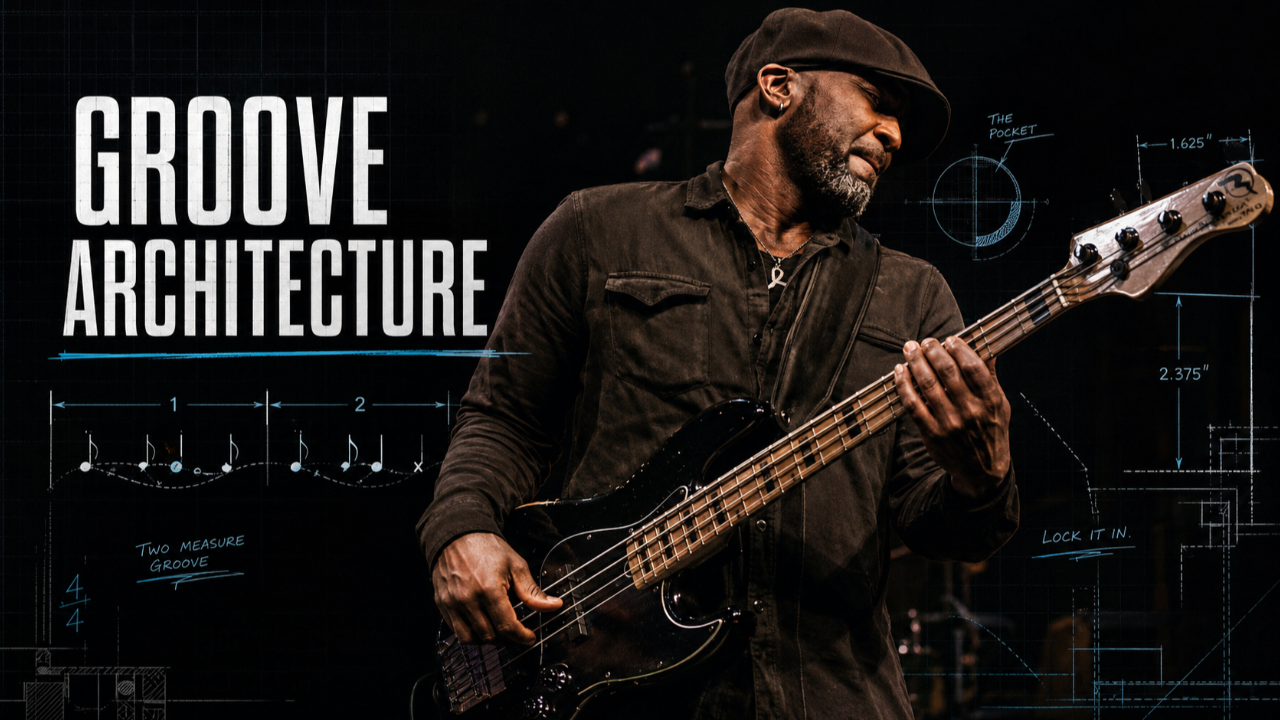
This post is for bass players who think groove is some mysterious thing you either have or you don't.
By the end, you'll be able to build a bass groove from the ground up using a simple framework, instead of guessing your way through it.
- Step 1: Start with the two-measure box
- Step 2: Build the rhythm first (rests count too)
- Step 3: Add harmony with two shapes
- Step 4: Always come back to the source
Step 1: Start With the Two-Measure Box
Most of us think about groove in a very abstract way. Ask somebody what "the one" is and you get a bunch of esoteric stuff back. But here's the thing. Groove is concrete. You can see it.
When you learn how to build a bass groove, start with the architecture. Almost every groove you know and love, the ones you can sing and hum, is built off a two-measure pattern that repeats. The fills, the dynamics, the space. All of it lives inside that two-measure box.
Think of it like Lego blocks. Two measures, with variation over time. That's your container. Everything you do fits inside it.
Step 2: Build the Rhythm First
Before you touch a single note choice, feel the rhythm. Rhythm is patterns of sound and silence. And listen, the silence matters just as much as the sound. Rests have to be played too.
Try this. Play just the downbeat of beat one and the "a" of beat two. Leave the rest blank. Rest, blank, rest. You know the feel. If you wrote it out it would be a quarter note, an eighth, a dotted eighth rest, a sixteenth. But ain't nobody got time for that right now. Just feel it.
Once that rhythm is locked in your body, the drums are implied even when they're not there. You and the drummer are both responsible for that relationship between rhythm and harmony. Hold up your end.
Step 3: Add Harmony With Two Shapes
Now we choose notes. You don't need fifty scales. You need two shapes.
Start with your octave shape, the bread and butter. From there, see the dominant seven shape and the minor seven shape on your neck. The only difference between them is the third. Dominant seven is root, major third, perfect fifth, flat seven. Minor seven is root, minor third, perfect fifth, flat seven. One note changes the whole color.
That's the ground floor. When you add those chord tones in, you start to inform the harmony. The flat seven is cooler than the octave. Sneak in a major third and the whole thing lifts. You're not playing chords like the guitar player. Your job is to outline the chord. If you want a deeper system for choosing notes that actually sound like music instead of exercises, that's the whole idea behind The Conversational Bassist.
Step 4: Always Come Back to the Source
Here's what holds it all together. No matter what fills or variations you throw in, you come back to the source groove. That repeating two-measure phrase is home base. You leave it, you decorate it, you return.
That's the part people miss. They keep adding and adding and never come back. The groove gets lost. Pick your source, loop it, and let it breathe. Variation only works when there's something steady to vary from.
And you know what the audience cares about? Not your gear. Not how much theory you know. They care that you're holding it down and that you mean it. You want people to feel it, you've got to feel it first.
Groove is not as abstract as we make it seem. It ain't rocket science. It's pocket science.
So what's a groove you love that you can hear the two-measure pattern in? Drop it in the comments and tell me what you hear.