Groove and Timing for Bass Players
Most bass players do not struggle because they lack information. They struggle because they have more information than they know what to do with. It is like knowing the alphabet, a few words, and some grammar rules, but still not being able to hold a real conversation. This guide will help you turn scales, patterns, theory, and grooves into a musical language you can actually use — so you can lock in, respond with confidence, and play bass lines that make sense.

Bass is the link between rhythm and harmony.
Your job is not just to play low notes. Your job is to connect the drums to the chords and give the song a foundation it can stand on.
The drummer gives the music its movement. The harmony gives the music its direction. The bass lives right in the middle, turning rhythm and harmony into one grounded musical statement.
That is why a bass line can be simple and still be powerful. When the time feels good, the notes support the chords, and the groove sits in the right place, the whole song feels better.
Great bass playing does not call attention to itself every second. It gives the music weight, direction, and a place to land.
Groove is the conversation between rhythm and harmony.
People say groove is feel, pocket, or making people move. All of that is true, but it is not specific enough. For bass players, groove is the organized interaction of rhythm and harmony that gives the song a stable, predictable foundation.
Rhythm
The drummer supplies the clock. Your bass line has to respect the pulse, subdivision, and placement of the groove so the music feels stable instead of shaky.
Harmony
The chords supply the meaning. Your notes tell the listener where the song is, where it is going, and how each musical moment should feel.
Foundation
The bass connects the two. Your job is to tell the band when something is happening and what is happening at the same time.
If you lose the one, you lose the groove.
The one is not just beat one. It is your orientation point. It tells your body where the music resets, where the groove breathes, and where the bass line gets its authority.
A lot of bass players get lost because they are chasing notes instead of feeling the form. When you can feel the one, you stop guessing where you are and start moving through the music with confidence.
The pocket is where timing becomes feel.
Playing in the pocket does not mean playing like a robot. It means your notes sit in a way that makes the whole band feel better.
Sometimes that means sitting right with the kick. Sometimes it means laying back. Sometimes it means leaving more space than your hands want to leave. Pocket is not about doing more. It is about making the right thing feel inevitable.
These are the habits that make bass lines feel shaky.
If your playing sounds busy, stiff, rushed, or disconnected, one of these is usually the reason.
Overplaying
Too many notes can cover up weak time. A simple bass line played with authority will usually beat a busy line played with anxiety.
Rushing Fills
Most fills fall apart because the player speeds up emotionally. The fill has to return to the groove, not escape from it.
Ignoring Space
Space gives the groove shape. If every gap makes you nervous, your bass line will sound like it is talking over the song.
Weak Note Endings
The end of the note matters. Cutting notes off cleanly is one of the fastest ways to sound more professional.
Not Listening to the Drums
The bass and drums are not separate jobs. The kick, snare, hi-hat, and bass line create one rhythmic machine.
Starting From Zero
Strong players rely on reusable vocabulary. They are not inventing a new language every time the song starts.
Five groove exercises for bass players
These are simple on purpose. The goal is not to impress yourself. The goal is to build timing, confidence, and control that survives real music.
1. Root Note Lock
Choose one chord. Play only the root note with a metronome or drum loop. Focus on making every note land with the same confidence, tone, and length.
2. Two-Bar Groove Loop
Create a two-bar bass line and repeat it for five minutes. Do not add fills. Your job is to make repetition feel better, not busier.
3. Rest Bar Discipline
Play two bars, then rest for one full bar. Come back in without rushing. This builds internal time instead of depending on constant motion.
4. Kick Drum Marriage
Put on a drum loop and match the kick drum exactly. Then experiment with leaving space around the kick while keeping the groove solid.
5. Note Length Control
Play the same groove three ways: short notes, long notes, then mixed note lengths. Notice how the same notes create a completely different feel.
Bonus: The One Check
Mute your strings and count the form out loud. If you cannot feel where the one lands without playing notes, the groove is not fully internalized yet.
Stop guessing. Start speaking bass.
If this way of thinking makes sense to you, these are the next two resources I would point you toward.
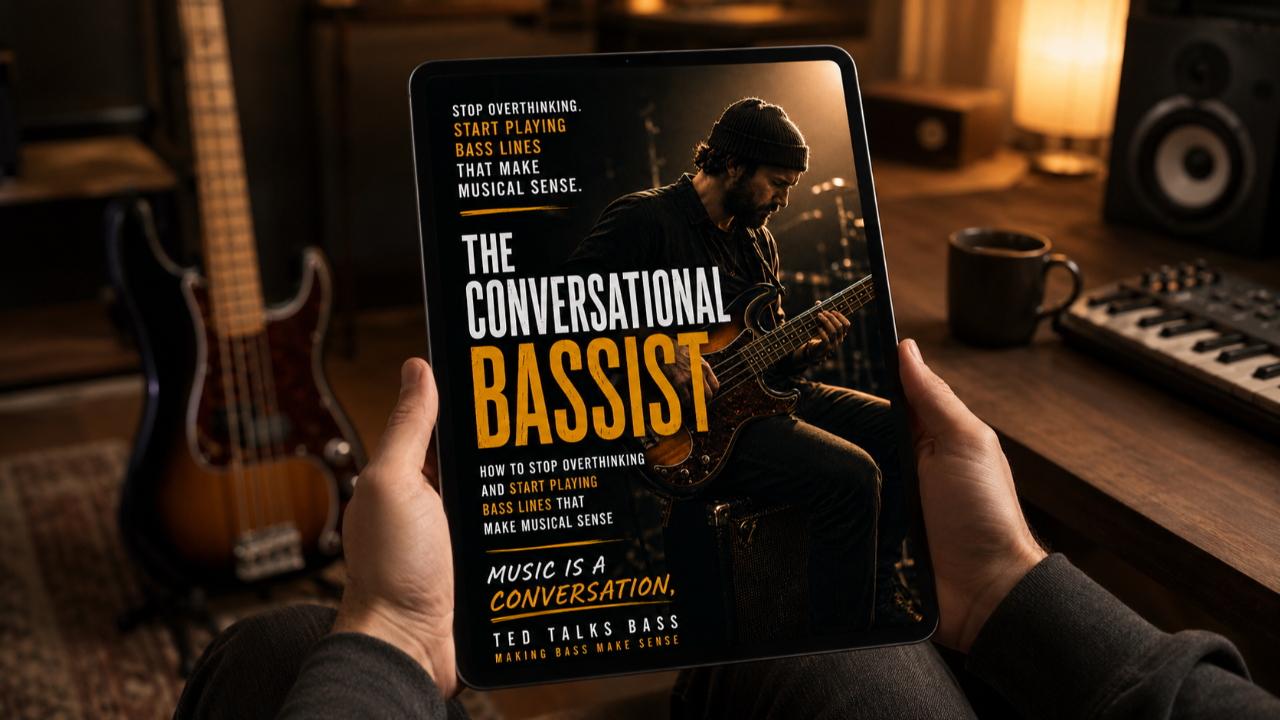
The Conversational Bassist
A practical guide for bass players who are tired of overthinking, freezing up, and treating music like a test. Start here if you want the core mindset shift.
The Language of Bass
The complete learning path for players who want a deeper system for groove, vocabulary, fretboard awareness, listening, and real musical confidence.
It ain't rocket science. It's Pocket Science.
You do not need to become a theory professor to play better bass. You need to hear the music, feel the time, build usable vocabulary, and learn how to respond with confidence.
Get The Conversational Bassist